Showing posts with label review. Show all posts

Friday, November 24, 2017

Rules Review - Daisho


The last of my "planned" reviews of Samurai Skirmish games is Daisho.  That is at least till Saga 2nd edition, with a Samurai expansion comes out (if it comes out, I believe I spotted a samurai miniature in their teaser video).  Daisho rounds out the available skirmish sized games that I know of for the Samurai genre.

It is a ruleset authored by The Ministry of Gentlemanly Warfare who also authored In Her Majesty's Name (IHMN) published by Osprey.  In addition to that they have a dark ages ruleset called Blood Eagle and an expansion to IHMN called Gothic.

It should be mentioned one of the highlights of reading these rules is Section 1.6, The Golden Rules.  An excerpt:
  • "Rules are for the obedience of fools and the guidance of sensei."  Which goes on to state, if there is a rule that you and your opponent dislike, then change it if all players agree.
And covers things like respecting your opponent, conduct, etc.  I guess it should be expected from guys that call themselves "The Ministry of Gentlemanly Warfare."  

Scale of Game:
The rules for Daisho recommend 200-250 points as a good starting level to get to the know the game, after which you and your opponents can agree on a point level for future games.  Note, I said opponents as the game accommodates 2+ players.  Referencing a couple of example warband lists in the rules, the Ronin list weighs in at 240 points with 6 figures and the Clan Patrol list is 300 points with 8 figures.  Both lists contain multiple samurai.  Unfortunately, the rules do not provide an expected game length for playing at various point levels.

Standard Rules:
Before really jumping into the standard rules/mechanics of the game, like it's sister game In Her Magesty's Name, Daisho offers 3 levels of play:
  • Basic - This levels lacks Ki, Magical Powers and weapon qualities and is meant more for the historical players.
  • Heroic - This moves the game slightly beyond "historic" but not into magical/fantastical realms.
  • Legendary - Everything.
I will note up front that the game does not allow for (unless you and your opponent agree to change it) pre-measuring.

Daisho uses what I am going to called a "Phased Alternating Activation" system, by that I mean the turn is broken into multiple phases which are completed by all players before moving on to the next phase.  The highest initiative roll (d10 + highest leadership in their warband) goes first at the beginning of each phase, then the next player goes and so on.  These phases include:  Initiative, Movement, Shooting and Fighting.

Attacks are resolved based on the model's corresponding stat (Shooting or Fighting) + the weapon modifier +/- other modifiers (cover, etc) + d10 vs the target's armor rating.  Achieving/exceed the target's armor rating is a hit.  In both cases of shooting and fighting, a model can split its stat into multiple attacks albeit against different targets.  Ie, if a model has a 4 Shooting it could shoot once at Target A only using 2 Shooting and a second time at Target B using the remaining 2 Shooting (all other modifiers still apply).  Also included are rules for combined attacks, allowing weak models to group up to fight difficult targets.  Fighting includes an option to try to disarm your opponent.

When a model is hit with a successful attack, it must immediately make a Karma roll which is modified by weapon used in the attack.  If the roll is less than the model's Karma stat it is out of the game (unless it receives medical attention) and if the roll is equal to the model's Karma stat it is knocked down.  And if the model is taken out of the game, the attacking model immediately gains 1 Ki which is used to activate Ki powers.

You gain honour (using "their" British spelling) points throughout the game, totaled at the end to determine the victor.  Hounour points are gained based on Objectives defined by the scenario, the social caste of models killed, reputation, survivors/prisoners, beast/magical creatures and anything else specified by the scenario.

Any rules beyond what has been mentioned are fairly typical/straight forward.  There is a noticeable absence of a morale mechanic but maybe the intent is that is abstracted into the Karma roll.

Other Things:
Daisho provides full capability to build your warband how you want to.  This includes armor and weapon point costs, as well as a robust selection of skills/ki powers, and magical powers.  These combined with the base point costs of the model's stats determine its total point cost.

The game also provides a system/framework for campaigns.  Campaign systems can often be pretty tricky to pull off and often can be abused, with no real way to evaluate them until playing through them (sometimes multiple times).  That being said, what is offered here in Daisho looks really good and is fairly flexible.

Scenarios:
The game provides a nice, diverse set of scenarios for games which include search and recover (with 2 setup options), rescue/capture, vengeance, breakthrough, assassination, outpost defense, plus about 10 more.  This already adds a lot variety to individual games but you can augment that further by adding a "complication" to the scenario.  This includes things such as sacred grounds, fog/mist, civilians on the battlefield, twilight, plus many many more!

And going a step further the rules suggest typical landscapes across Nippon that would be suitable for your battles.  This is not something I would really consider "necessary" but it is a real nice touch that I am not sure I have seen any other game do.  Of course, it does cause me a bit of anxiety in thinking "I gotta build all this!"  Note, I'm not saying you "have" to build this to play Daisho.  I'm just saying "I HAVE TO BUILD ALL THIS" (in a good way... sort of... mostly...).

Concerns:
Honestly, I don't have any major concerns about the game, only a couple of minor ones.  The first of which is availability:  I held off on reviewing Daisho for quite some time because I did not want to shell out the money for a hard copy of the rules, at the prices and shipping I was able to find.  But I finally found a e-copy of the rules at a very affordable price here.  And at less than 100 pages, it would not be terribly expensive to get this printed off/bound nicely at Staples, esp since the e-book is very printer friendly and can easily be done in black & white.

I guess that kind of brings up a second "concern."  There are no illustrations/pictures in the rules depicting gameplay examples.  There are detailed written examples throughout the rules however and because of this I never found a situation/rule complicated enough to warrant a visual illustration.

There is also some minor record keeping with whether or not a model has moved/ran.  And the "phased alternating activation" could make record keeping a little more difficult.  Honestly though, the game is potentially such low model count that I'm not sure these things need to be explicitly tracked and there is likely a slick way to do it.

Conclusions:
I find my feelings toward Daisho a bit odd, it is based heavily on the IHMN ruleset by the same authors.  I actually read those rules this summer to get a feel for what Daisho would be like, since it was easily available from Osprey via Amazon.  The reading of IHMN caused me to hold off on acquiring Daisho until now because I was not impressed with it.  Maybe I am in just a good mood now or maybe my taste have changed since then (there have been a number of wargaming concepts that I am, maybe, shifting my views on) but I really like these rules.  They offer everything I think I was looking for.  Of course, I can't really say that until I have played a few games but this looks like a very solid contender.

I will eventually get Daisho added to my list of games of this genre on the Samurai Skirmish page.  It is definitely worth trying out and is now the top of my list.

Wednesday, November 22, 2017

Rules/Game Review - Aristeia!


I just received my copy of Aristeia! and thought I would post up my initial thoughts.  As I wrote the title of this post, I found my self conflicted about just labeling it a "Rules" review.  I want to say I feel it is more of a "Game" review but what does that mean?  Why the distinction?  Is it the old "it's played on a board, so it's not a miniature game" mentality?  Is it because it is self contained?  Is it because it is more "structured" than a regular miniatures game?  I'm not completely sure.  Maybe it is because I plan, at least as I am currently typing, to talk more than just the rules (specifically to comment on the components and miniatures).  Yeah, that must be it.

Enough rambling, back on topic.  For any not aware, Aristeia is a new game from Corvus Belli set in their Infinity universe.  Aristeia is new sport sweeping through the Human Sphere, an arena combat blood sport.  I have been a big fan of Infinity's fluff and miniatures since the very beginning but the rules have never been to my liking.  With the release of Aristeia I hoped to find a way to enjoy the Infinity universe and miniatures without dealing with the rules of Infinity.  Ideally Areisteia also checks some of my other favorite boxes:  arena/gladiatorial combat and/or "blood sport."

Scale/List Building:
Scale of the game and list building are about as simple as you can get:  any 4 characters per side, although the rules do offer that you can (if the players want) draft characters from a pool before the start of the game.  After selecting your characters, you assemble your Tactics deck out of a set of 10 fixed standard cards and 2 selected character specific cards (out of 4 possible cards, currently) for each character on your team, giving you a total deck of 18 cards to draw from.

Rules:
The game begins by determining which player is the underdog, accomplished by adding up total initiative values among your characters.  The player with the lower number is declared the underdog for Round 1 and will get to determine how tied initiative values or simultaneous effects are resolved.  After Round 1 the under dog designation belongs to the player with the lowest number of Victory Points.  Once characters are deployed, each player secretly places each of their characters in the initiative track positions, which are numbered 1-4.  Then starting at position 1 on the initiative track, each player reveals their character and compare its initiative value (the higher value getting to decide if they or their opponent will go first).  The active character then gets a number of actions equal to their action value, which can then be spent moving, attacking and using character skills.  Then the un-activated character in the 1 initiative position activates.  This process proceeds through position 4, after which the game proceeds to the objective phase and then the recovery phase,

The core resolution mechanic of the game uses the character card to specify the number and types of dice to roll for each skill/action.  These are d6 dice of different colors and with special symbols, ala X-Wing, Armada and many other games that have recently come on the market.  Two type of rolls exist in the game.  The first being an unopposed roll or simple roll, usually a character skill check like using a medkit.  The second is an opposed roll, usually for combat, where both players roll, cancel results, and compare totals.  Additionally, special triggers (called switches) can occur based on the results.  It should be noted that this resolution mechanic also allows the defender to potentially injure the attacker, as well as both characters being injured.  Reducing an enemy to zero wounds provides the attacker with a frag counter (used to resolved tied victory points) and also allows them to draw a card.

If a character is reduced to zero wounds, it is moved to the infirmary and if that character has not activated yet, it basically looses it's activation that turn.  During the recovery phase, all characters in the infirmary are moved to the bench and receive a -2 action token.  At the beginning of the next round benched characters can move onto the field when activated but they will enter play again albeit a slightly reduced capacity with less action points.

Objectives are scored at the end of each round and totaled at the end of Round 5 to determine the winner.  You also draw a tactics card at the end of each round and an additional card if you scored any VPs that round.  The rest of the game and mechanics are fairly typical and straight forward.

Scenarios:
There are 4 basic scenarios provided, with a promise of more to come, with each scenario providing different objectives for scoring points.  I think the inclusion of only 4 scenarios is a bit light, hopefully the community/Corvus Belli will be quick to develope/release new ones.

Components:
I found the components of the game to be of very good quality.  Nice thick playing board, punch out tokens, nice quality cards and excellent box control.  The one, possible, exception to this is the plastic miniatures.  The detail in the miniatures is a little suspect but I wont really know till I start to paint them.  They are certainly decent quality "board" game miniatures but honestly, I had slightly higher hopes with this coming from Corvus Belli.  In fact, I was really excited to see what Corvus Belli would do with plastics.

Additionally, while the miniatures come assembled, they are cast as multi-part models and assembled in the factory.  The "quality" of this assembly process is likely to vary greatly but several of my minis have significant gaps that will have to be filled before painting.  And maybe that was not the assembly, maybe that is the miniature itself but either way it is a slight disappointment.  The miniatures are also pre-attached to bases which is not a big deal except they are completely blank bases.  That just seems like they missed an opportunity to put them on some nice flight deck type bases that Infinity miniatures typically shine on.  And it is going to make it a pain in my ass to re-base these miniatures.  Also, why are these not the typical 25mm sized bases found in Infinity, not that it matters game play wise, just wondering.

The entire plastic miniature thing also raises another question, did I make the right choice?  Should I have bought the collectors edition which game with a metal set of miniatures (in addition to the plastic ones)?  I assumed the future expansions would be in plastic, so I opted for just the regular version with plastic minis for "consistency" and to satisfy a bit of OCD-ness.  As it happens, during writing this up, I found confirmation that the expansions will be plastic.

I can also understand that hitting the right price point for the game is one of the most important things a company can do.  That being said, a simultaneously release of plastic obstacles/terrain (rather than the 2d punch outs in the core box) would have been very appropriate in my opinion without raising the box price with their inclusion.  Or at least an announcement that it was in the pipe.

Standouts:
There are a couple of very clear standouts in this game to me.  The first is the getting started booklet is fantastic.  I really appreciate the industry trend in this direction but I believe Corvus Belli really nailed it.  It does the typical good job of introducing the concepts in a clear, logical order and provides examples at every turn.  It also provides a suggested build for your first game, again somewhat typical.  It then walks you through a complete example first round with these builds, which is a lot less typical.  Maybe this is not "necessary" but I appreciated it.  I will also note the booklet sized rules reference, weighing in at only 28 half-sized pages, has a table of contents, an index, and a quick reference sheet.  Very nicely done.

Note, these are the metal miniatures from the collector's box.
A second standout is the character design.  I really love the design of this first batch of characters.  They are all different and unique, reflecting an individual personality.  They all seem to have different abilities/skills and purposes.  I can't help but be reminded of the Overwatch video game.

Concerns:
As a very odd coincidence, this game arrived at my doorstep just a day after a local gamer had shown me how to play GW's Shadespire.  I say odd, because I find the two games strangely similar.  I don't really view this as a problem or concern, it is just that the recent exposure to Shadespire made a couple of things jump out at me when reading through the rules for Aristeia.

The first of which is that I really missed the "dynamic/unknown" objectives of Shadespire and thus found Aristeia a little static in in that respect,.  Maybe this will be resolved with new scenarios in the future.  The second is with its deck building element:  Will it follow the same buy-to-play model (where you have buy an expansion you don't want just to get access to certain cards:  X-Wing, Armada, Test of Honour) that Shadespire does?  And lastly, will the game itself be fun?  Because while I found nothing mechanically wrong with Shadespire, I'm not sure it was fun.

The price point for this game also seems little off at ~$70 RSP.  Since you are buying a full game, comparing price per model to a box of space marines (for instance) is not fair but there is some argument that one can compare the price per model to other "full" games like Shadespire, Necromunda, Mice & Mystics, Tail Feathers, so on and so on.  So at ~$8.75/model, it is pretty high without having the plastic quality of some of the other offerings (Games Workshop).  And compared to Zombicide Black Plague (which has great quality, IMO)  it is sinful.  Furthermore, comparing the cost to Operation Ice Storm/Red Veil for Infinity (which are full 2-player starter boxes) is more disheartening (pretty much the same costs per figure).  The expansion boxes better come in at less than $15 each (with 4 figures) if this plastic quality continues and I highly doubt they will be that cheap, which does not bode well for the game.

Conclusion:
I am very interested in trying this game out and I really really hope it is fun, but I think the price point is off.  It seems to be a nice, tight ruleset and should allow quick games to unfold while still providing nice depth of tactics.  That being said, if Corvus Belli does not provide a constant and consistent stream of support for this game (Organized Play, new releases, new scenarios), I think it wont stand out among the crowded crowd (here is a great video demonstrating Corvus Belli's planned support for the game - it looks like full commitment).  You also should not expect, even though it is Corvus Belli, the plastic miniatures to be insanely good (they are decent board game quality in my opinion, although mine have some unfortunate gaps).

I would love to see this game expanded to multi-player.  Mechanically, nothing is jumping out at me right now as a reason you couldn't do it.  Except the board and deployment zones maybe, but that would be an excellent reason to explore (and sell) different shapes and designs of boards...  Just saying...

Lastly, I had decided a while back to not spend so much time reviewing rules that are freely available, you should and can just go read them for yourself after all.  But I did not know these rules are available for free until I had wrote this up.  You can find them here.


Saturday, October 21, 2017

Rules Review - Bushi no Yume


Knocking another Samurai skirmish ruleset off my list with a review of Bushi no Yume.  I initially read the rules a while back but have really struggled with how to write a review for Bushi no Yume.  See, I am pretty ignorant when it comes to a particular ruleset that is fairly well known in the world of miniature agnostic skirmish games:  Ganesha Games' Song of Blade and Heroes (SBH) but what little I do know seems consistent with what is presented in Bushi no Yume.  Which caused me to ponder "how" to write a review (full review, delta review, cop out review).

Ultimately, the author took the time and effort to put Bushi no Yume together so I figured I should at least treat it as a stand alone game in reviewing it.  As such, I will make no other mention of SBH except to say that you do not need it, or be familiar with it, in order to play Bushi no Yume.  You can find lots of helpful information regarding Bushi no Yume here.

Scale of Game and List Building:
The rules state that a standard game should be around 5-10 characters, costing 60 koku (points) total,  with games of this size being playable within one hour on a 3x3 ft table at 28mm scale (there are conversions for distance for multiple scales).  Increasing the game size to 10-20 figures, costing 100-120 koku (points), should be playable within 2 hours.

List building/force composition for a 60 point game, limits that only 45 points can be spent characters which are classified as personalities with no other restrictions.  I believe that beyond that, your force can be completely personalized including building characters from scratch if you desire.

Standard Rules:
There are a few core concepts for Bushi no Yume that are important to understand as they are a departure from most skirmish game systems.  The first is the characteristics of each model has essentially been reduced down to two stats:
  • Bujutsu (fight) - How well the character can fight.
  • Kyu Grade (quality) - Roll up of all non-fighting characteristics
In addition to this characters have a Buki (primary weapon) that affects their Bujutsu and possibly Nouroku which capture abilities/special powers of the character.

The second key concept is the activation system.  At the beginning of the game, players roll to see who has initiative, with whoever winning the role retaining initiative every turn.  After the first turn, this test turns into a Karma Card Roll (more on what this means later).  The player with initiative will then select a model to activate, choose the number of actions (between 1-3) they wish to perform, and then perform an Activation Roll.  This is a test against the models Kyu Grade, rolling a number of dice equal to the number of actions declared.  For every success, you get one action.  If you only have 1 failure you may activate another character afterwards.  2 or 3 failures passes play to your opponent (either immediately or after your action depending on if there is any successes).  There is a fairly standard list of actions that accompany this system, some of which costing more than just one action.

While most characters have standardized movement values, there are a couple of major departures in the movement system.  Firstly, the distance moved is measured from the front of the base to the rear of the base such that larger based models will have slightly more movement.  The second difference is that while you do not have to move the full distance, you do have to move in a straight line such that if you want to negotiate around an object/corner you must use multiple moves to do so.

Combat resolution is accomplished in an opposed roll manner.  In the case of ranged combat, the attack can end up missing, forcing the target to cover, or possibly wounding, or outright killing the target.  For close combat, the combatants may end up disengaged, the loser forced backwards with possible followup from the winner, or the loser possibly wounded or outright killed (note, armor is factored in before determining the result).  If a character is possibly wounded, it performs a wound test at the beginning of that player's next turn with results ranging from flesh wound to dead.  Typical rules and modifiers apply to combat.

That being said, there are some additional fidelity to combat that are not often found in miniature games.  There is an hierarchy of weapons, from best to worst, which give combatants with better weapons than their opponent a bonus.  Long reach weapons also accounted for.  Additionally, the type of damage a weapon inflicts (impact vs cutting/piercing) affects the target number for the wound test.

Scenarios:
The rules give several scenarios to offer something more than just kill the other guy.  That being said, killing the other guy most of the time seems to be the sure path to victory.  There is a simplified campaign system also included, as well as an advancement system.

Other Things:
There are some additional rules, not mentioned above, that are covered in Bushi no Yume.  This includes a morale system, karma cards, Ki, mythical creatures, and even a magic system!  The karma cards, which replace the initiative roll at the start of each turn after the first, add a bit of unknown to the game by adding positive modifiers, actions, or events when played (one lets a character slice up arrows with their katana if fired at).

Ki is kind of interesting in that each character starts play with 1 Ki and at any time to modify one of their dice rolls +/- 1.  And every time a character rolls a natural 6 in combat, than recieve an additional point of Ki.

Magic seems fairly abstracted, much like it is in Kings of War but glad to see its inclusion, as well as the inclusion of mythical creatures.

Concerns:
I am inclined to have several concerns regarding the Bushi no Yume rules but I also feel that should not express them without having tried the game, which I have not.  Probably my biggest concern regarding Bushi no Yume can be rolled up into "acceptability":  Will I (as well as those I try to convince to play) find the rules acceptable.  This stems from the fact that there are several concepts, that are a foundation to the game, that are pretty major departures from standard miniature wargames.

Outside of the major departures, there is one additional concern though and that is how the rules are written.  I do not mean to imply they are badly written, quiet the contrary they are well written.  It is the fact that to introduce "flavor" it over uses (in my opinion) Japanese naming conventions.  See above in this review, I used Koku and other terms.  It shows a great love and care for the genre for the author to do this but it also makes it hard at times to digest the rules.  And as I game that I may try to introduce other people to, it is a factor I would have to consider.

I also feel the additional fidelity of combat captured by the hierarchy of weapons and some other particular modifiers may add to much "work" to the game.

The last thing that gives me a slight pause is the opposed combat roll system.  I am a big fan of this approach for combat resolution but I have always been concerned that it favors range combat over close combat.  That is because range combat usually represents zero risk to the attacker, while close combat has a significant (at least by comparison) risk.  Most systems tend to address this imbalance by limiting the amount of range combat units/models you can use, but this restriction seems missing in Bushi no Yume.  Then again, maybe it should be left up to players to build their lists accordingly.

Conclusions:
If I am correct that Bushi no Yume is very similar to SBH (I know, I said I wouldn't reference it again) then I can see why SBH appears to be very polarizing in the gaming community.  I'm interested to try it out so that I can "give it a fair shake" but honestly I am afraid I wont like it.  And if I do, I am afraid it would be a hard sell to other people.

That being said, it is one of the few games in this genre that I think could give me a bit of that Akira Kurosawa movie feel that I want:  Through it's wound system and activation system.  And it is the first that I have reviewed to introduce fantastical elements into the game, other than Ki in the Torii rules.

Adding this to the list of games of this genre:  Samurai Skirmish as it is at least worth considering and/or trying out.


Sunday, July 9, 2017

Rules Review - Ronin


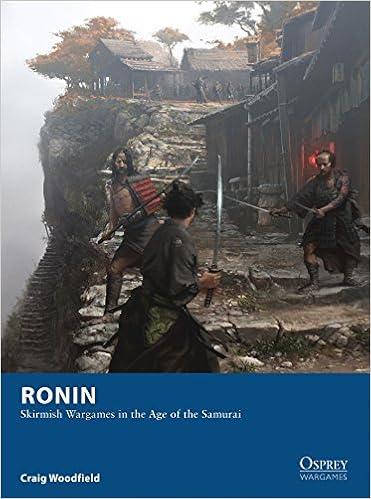
Ronin was another Samurai skirmish ruleset that I wanted to review.  It's a ruleset from Osprey Publishing that came out a couple of years ago.  Despite picking this rulebook up literally days after it was available, I had never sat down and actually read the rules.

Scale of Game & List Building:
The rulebook states that Ronin is intended for 4-20 miniatures per side and suggesting that 100 points should equate to < 10 figures and about an hour of game time.  So it sounds in line with my taste.

The force composition rules are not as simple to summarize though.  The first thing to understand that each potential member of your force can have a Rank of 0 through 5.

  • Rank 0:  Basically a peasant that has picked up arms
  • Rank 1/2:  Basic troop
  • Rank 3/4:  Elite troop
  • Rank 5:  Best of the best
Depending on the faction you choose to play, you will get various composition requirements based on the ranks above.  For instance, one faction may say that you can only have one Rank 3 troop, per every Rank 1 troops your force has.  Additionally, many forces dictate that no more than 50% of your force may be armed with missile weapons and no more than 25% of force can have a teppo (flintlock rifles).

Given the typical composition rules, it would seem to me that no matter the point total you and your opponent agree upon, you will probably tend toward the higher end of model counts.  Still, 20 figures is within my preference level.


Standard Rules:
Ronin is basically an alternating activation system, although this occurs at the phase level.  There are 5 phases to each turn:  Priority, Move, Combat, Action, End.  The Priority phase simple determines who can go first for each of the Move, Combat and Action phases and is handled with a simple d6 roll off.  As far as I recall, nothing else factors into this roll off (it would have been nice to see some modifiers/something that added a little more depth than just a random roll).  Morale is also handled during this phase.  The End phase is simply a maintenance/clean up phase, so timing is simultaneous.

The Move phase is actually exactly how it sounds, although there is one exception.  Movement is standard for all troops:  6 inch standard move, 9 inch run with modifiers for certain conditions.  The interesting part of the Move phase is that it is an "opportunity" to shoot.  I say opportunity, because you can also shoot range weapons in the Action phase.  Even if you shot during the Move phase.  Yes, you can shoot twice per turn (this is potentially ok though, as I will eventually discuss) unless it is a weapon that requires reloading (teppo).  Shooting during the Move phase is considered a hurried shot and suffers a penalty.

The Combat and Action phases are also exactly what they sound like.  Combat resolves all the melee combats and the Action phase is where actions are performed, including standard shooting.

In each the Move, Combat and Action phases the player with priority determines who goes first.  After the first players action, it alternates to the other player and so on until all models have acted or passed.

Since shooting can first occur during the Move phase, let's discuss how that is resolved.  Shooting is simply a 2d6+characteristic+/-modifiers against a target number of 6.  If successful, the damage is equal to the difference.

Combat, is actually resolved a little differently and is little shocking at first.  The Ranks of the models involved determines each sides combat pool.  This combat pool is secretly divided between Offense and Defense.  Initiative is determined for each model involved in the melee with a d6+modifier roll and the highest initiative get an opportunity to to attack.  If the model does attack, it removes a Offense token for his sides pool.  It's then a 2d6+modifiers roll against the targets 1d6+modifier roll.  This is where I was scratching my head a bit, since that seems a bit "unfair."  Well, the reason is each side actually gets a chance to "enhance" their roll by removing another appropriate token from their pool and if you are paying attention, the defender has not spent any tokens yet.  So if the target has no defense tokens, or chooses not to use them, then I guess the philosophy is that it's not trying very hard to defend itself and therefore should be easier to hit.  Interesting.

Note though, I said each side can "enhance" their attack.  If the attacker does enhance its offense for that attack they get an additional die, bringing it up to 3d6, but can only keep the best 2 results so its not quite as huge of an advantage as a straight 3d6.  Like shooting, if successful the damage is determined by the difference.  Then you move to the model with the next highest initiative and basically wrap and repeat until no offense tokens remain.

Damage is also kind of interesting, as models do not have a number of wounds.  Which seems really weird given I have just been talking about damage being the difference between 2 numbers.  This is because damage equates to a level of wounds, and wounds stack up to higher level wounds:

  • Damage 1:  Stunned
  • Damage 2/3:  Light
  • Damage 4/5:  Grievous
  • Damage 6:  Critical (killed/out of action)
While stuns do not "stack" in the sense of a cumlative effect, you do track each stun because during the end phase a variable amount of them are removed.  A light wound on top of a light wound is upgraded to grevious.  A model with a grevious wound that suffers any wound (even stun it appears) is upgraded to critical. Note my wording in these, it appears intentional that if a model has a light wound and then suffers a grevious wound then it only has a grevious wound.  Appears is the key word though.  Wounds also impart modifiers on several things (movement, combat modifiers, etc).

Beyond that, the rules allow for basic special rules (kinda like key words), mounted models, special attacks (disarm or subdue), and weapon specific modifiers and special rules.


Other Things:
The rulebook is fairly well laid out although there are a couple of minor issues, IMO.  The first is my (and a lot of other gamers) typical gripe in that there is no index.  Yes, it kind of does not need one since it is fairly short the Table of Contents does manage fairly well.  Still, when will people learn that "we" want indexes.  The second is the rules could be better broken into clearly distinct sections.  Things just seems to roll from one topic into another without much notice, making it slightly confusing (or making me just an easily confused old man).

There are a lot of different factions to choose from that can be very distinct just from the composition rules alone.  There is a suggestion for a campaign advancement system but nothing strictly laid out.  There are also advance rules for adding in another tactical layer via fatigue and a resilience stat, which seem kind of odd to me to have these as an advance rule as the game overall seems simple enough to tolerate this additional layer.

The scenarios seem a bit of an after thought.  VPs for a scenario are primarily driven by the Rank of the models killed.  But each player also randomly determines a secondary objective for the game, worth 5 VP.  Which is certainly enough to swing the game, it just does not seem like enough to back off the typical kill everything you can approach.

Some Issues:
I really not seeing any major/obvious issues with the rules.  In fact, I am pretty interesting to see how the entire combat pool thing works out for melee.  I may not like it though, its a little tough to say.  I am also still a little concerned that archers can shoot twice in one turn and damage is determined against a static number (that is slight below the mean for 2d6 rolls).  I believe that most factions limiting the number of range weapons to 50% is an attempt to offset this.  I also think that it maybe balances that melee guys can technically attack multiple times in a turn if they have a high combat pool and allocate it to offense.

I think the rules are really crying out for an expansion.  I would love to see better scenarios that really drive the encounter, rather than after thoughts.  A better advancement system would be great to, as would be a nice narrative campaign system wrapping around all of it.  Top of that expansion book with some options to add more fantastical elements to the game.  That being said, the game has been out for a couple of years now and we have not seen any additional support so I would not hold my breath.

Conclusions:
I think if you are interested in Samurai skirmish games, I think Ronin is worth trying out.  Given its one of the Osprey wargaming books, it is pretty cheap (I think I paid $14?).  I'm interested to see how the combat pool mechanic works out.  That being said, I am not particularly excited to try it and I can't really figure out why.  The only thing I can think of is;  If I threw down pirate models and changed the names of weapons and armor, then there would be nothing "samurai-ish" left to make it feel like I was playing with the wrong models.  What would make a game, any, feel "samurai-ish"?  I don't know.

Anyway, with this being my third review for samurai skirmish rules, you would think I had a bunch of models painted up waiting to go.  Wrong.  LOL.

Adding this to the list of games of this genre:  Samurai Skirmish

Saturday, May 13, 2017

Rules Review - Torii


Continuing to tilt at windmills, specifically for a Samurai skirmish game, I just revisited the Torii rules by Zenit Miniatures.  I had flipped through the rules a while back and I did not recall anything that was explicitly a show stopper, at least for me, so I thought it was worth going back and reviewing a little further and capturing my thoughts.  The rules are available for free and can be found here or from the main page of the Zenit website.

Although not the purpose of this review, I should point out that Zenit also offers a Samurai oriented mass battle ruleset called Kensei.  They also offer an wonderful range of Samurai models, in fact their range is the one I want to use for whatever ruleset I converge on (if I ever get around to it).  Unless something better comes along before then.  Anyway...

Scale of Game & List Building:
The rules advertise it is a game of 8-12 models per side, consisting of 3 categories of troops you can use to build your force, with the following restrictions:
  • Hero:  Must include at least 1.  No more than 2 are allowed and they must be different.
  • Elites:  Up to 4 may be included into your warband
  • Warriors:  No restriction
  • No more than 12 models total
  • Only less than half of the warband can be equipped with ranged weapons
You have 100 points to build your warband as above.  You can also spend points to equip them with mounts or range weapons or you can purchase Offerings for the Gods (rerolls).

While each category of troop shares the same stat line, the "force lists" expand this vanilla approach by offering different choices of Warriors (for instance) with different skills depending on the Clan they represent.  There are also common troop choices available to ever clan.  I really like this approach in theory and it appears to alleviate my first impression that the game would be very bland due to so much parity via the statline.

Standard Rules:
Torii is what I would call a "I go, You go" with reaction system.  Typically not my favorite form of activation systems but at least it has a reaction component.  In this system, the active player starts issuing and resolving orders to their models, where an order represents one or more actions (coming back to this in a second).  If more than one action is permitted (more on that later), it can not be a duplicate of a previous action that miniature has taken during it's activation, nor can you have more than 1 combat action per activation.  Any model that has received an order (either the active player or the reactive player) is considered activated and can not be re-activated that turn.  The active player then continues to activate their other miniatures and once they have finished all of their activations, the second player then proceeds to activate their remaining eligible models.

What is a bit interesting in all this is that the number of actions a model may have is variable and not determined until the command roll is made at the beginning of a model's activation.  A command roll is simply a 1d6 + initiative roll.  On a 4+,the model gets 2 activations, otherwise it just gets 1.  This seems kind of interesting but may end up being a bit of a love it/hate it type mechanic, at least for some.  Lastly, on a command roll of a 6+ the model activates it's "Ki" (some skills may only be used if this has occurred).

Back to actions.  There are a fairly typical set of actions available to the active player and a limited set for the reactive player.  It is worth noting though that some actions to require 2 action points, hence the command roll could really hamper your plans.

Torii is a d6 based system and most rolls utilize the appropriate stat, rolling that number of d6s with a 4+ being considered a success.  Close combat is resolved by each miniature rolling the appropriate number of dice (with modifiers) and counting successes (multiple of the same rolls, that are a successes, cause a crush bonus to be applied during damage resolution if that miniature wins the combat).  The miniature with the higher number of success is the winner and causes a number of impacts equal to the difference.  To resolve the damage, you roll a 1d6 + the difference from the previous step + modifiers (like crush):  on 1-4 the target is stunned, 5 or 6 is a wound.  It is clearly stated that stunned tokens are removed at the beginning of the turn but I'm not sure of the affect otherwise (can't be activated?).  It would also seem, although not clear, that 2 stunned convert into a wound.

Range combat works in a fairly similar way.  Except Line of Sight affects the target number for success:  4+ for clear LOS, 5+ for partially blocked LOS.  There are also modifiers to the number of dice you roll based on class of range weapon (ie, short range weapons like shurikens) and the range band it is firing at.  Outside of that, if the target reacted with an opportunity shot it is basically the same as close combat.  If not, then the difference in impacts is equal to the number of successes the attacker rolled.  If successful, then the damage is resolved.  Given the disparity in the number of impacts you can generate (versus Close Combat), it would seem that unopposed range combat could be very deadly.

In all cases, if a miniature is wounded it then must perform a Honor Test or it will attempt to flee the combat.  I would have liked to see some modifiers to this test, for instance if a warrior is within X of a Hero, it gets Y modifier to it's Honor Test.  Maybe it is buried in the skills.

Outside what I've already mentioned, the rest of the rules from there on seem pretty standard.

Missions:
There are 6 missions provided, each with a primary and secondary objectives and scoring.  A common primary mission is randomly determined and shared by both players.  Typically it offers 3 scoring elements of 1, 2 and 3 for a possible total of 6+ points.  Each player also receives a random and independent mission to score for their secondary objective, worth 2 points.  I am a big fan of this type of mission/objective approach.  My only concern is the disparity between primary scoring and secondary scoring would seem to make going for a secondary a very poor decision.  I would have to play through them multiple times to really tell though.

Other Things:
The rule book is fairly well laid out and would seem to flow well but I actually found myself searching around it a lot.  Something in the flow is just slightly off but I can figure out what.  That being said, from cover to cover it is only about 16 pages, if you exclude the skill list/definition and the force list, so it does not take long to find whatever you may need to look up.  There is no table of contents or index for the rules, but given how short the rules are I do not think this is a big issue.

It should also be noted, as written, that Torii does not allow pre-measuring prior to issuing orders, which is not a big issue for me but for some it may be.  Of course, you are likely to never to play this game in a tournament, so why don't you and your opponent just agree to play the way you want.  ;)

The rules also specifically call out that models should be mounted on square bases but honestly there is no mechanic that would seem to drive this.  I personally would consider this optional, just like the pre-measuring issue.

Weapons are handled fairly generically.  Close combat weapons are all considered similar.  Long combat weapons are just slightly different.  Range weapons are all fairly similar, only grouped into range categories.  Perhaps all that is for the best or perhaps it makes it a little to vanilla.

I should also mention the rules are in metric.  As a one time player and fan of Confrontation, this is really not an issue to me but I remember some people, at the time, were very adamant about their hatred of the metric system and unwilling to consider playing a game in metric.

As in Test of Honour, Torii appears to lack any fantastical elements.  Unless you consider the Ki triggering/allowing skills to take affect.  So this is a bit of a downside to me personally.  But in the case of Torii, I find this very odd (which I will come back to later).

Some Issues:
There are some slight issues with the rules, as presented.  I do not think there are any major holes in the rules, all the content seems to be there.  It is just I felt like I had to flip around a lot to find things.  For instance, as I stated above the close combat mentions "Crush", I figured that would be explained in the rules for resolving damage.  But it is not.  You find it in the skill section.  Which is fine, I understand this approach but they could have written "crush skill" or something that would have clued me in.  Also, I think the rules are simple enough to get away without having any diagrams or examples but I would I have still liked to have seen some.

As I mentioned when I covered range combat, it does seem on paper that range combat could be very deadly.  It is definitely good that the list building rules limit the amount of range weapons your force can be composed with.  But I still worry that it could be a little to deadly for my tastes.

The only other major issue I see is I am not sure of the support for this game.  I think it is great they are leveraging off of Kensei and the range of models they have for Torii.  But, why doesn't Torii have Clan profiles for all the great undead and Oni/monster models they released via crowd funding for Kensei?  And why are there no fantastical elements to the game rules to support this?  That hole leads me to have concerns about future support/intentions from Zenit for Torii.

Conclusions:
Torii may end up being a bit vanilla.  Maybe the simplified/unified statline utilizing skills approach will backfire, maybe it's a perfect solution.  But, since the rules are free and there is nothing that necessarily ties you to using Zenit's range of miniatures (therefore to me it seems fairly miniature agnostic), I think the game is worth trying out if you are interested in a Samurai skirmish game.  If it does not work out for you, you can always carry your miniatures over to another system (I suspect most rulesets for this genre that you will find are going to be miniature agnostic) and give it a try.

Update:
Right after I hit publish on this post, I found out Zenit has launched its Kickstarter for a second edition of Kensei (their mass battle Samurai rules).  Since I have not really looked into Kensei, I do not really have an opinion about it.  That being said, the Kickstarter does offer a lot of their miniatures and even a printed version of the Torii rules.  You can find the Kickstarter here.

Adding this to the list of games of this genre:  Samurai Skirmish

Saturday, March 11, 2017

Rules Review - Test of Honour


So for those not aware, Warlord Games recently released Samurai miniatures game called Test of Honour.  I read through these rules a couple weeks ago when the preview first because available and was pleasantly surprised.  I held off posting a review because I hoped that the "missing" rules would be available in the coming weeks and/or some other concerns would be elevated when it launched.  As I will get to, those concerns still exist but I still think this rule set deserves some attention.  At least it seems so to me, as I (also) love this genre.

This review will have some holes though, as there is content for the game that is not available for free.  In fact, only the Main rules are free, the Battle Guide and various "cards" are not.  You can find the rules over at the Warlord Games site.

Scale of Game & List Building:
Sadly I am really not sure.  For list building, the main rules say to refer the scenario being played in the Battle Guide for recruiting rules.  Which is fair enough and potentially interesting that game size could vary scenario by scenario, potentially even asymmetrically.  The description on the website claims a small skirmish game of 5-20 models, although this seems opposed to how the game is packaged (most commoner boxes are 10 models each, shouldn't this really be 3 or 6 if the game size target is 5-20 models, and you mutli-base commoners in groups of 3?).

It should be noted too, and I think has been stated by Warlord Games, that this is not really a game of Samurai vs Samurai.  It seems to be a game of 1-2 Samurai leading a small band of more common troop types.  No real issue to me, I only point this out as it may matter to some.

Standard Rules:
Building on the typical Warlord activation mechanic from Bolt Action (pulling dice from a bag), Test of Honor tweaks it slightly.  Instead of dice, it uses tokens where samurai are denoted with a different token than commoners.  Additionally 3 fate tokens are added to the bag.  Note, there are not separate tokens for each side.

The commoner vs samurai token distinction is made because commoners can only make 1 action per turn, whereas samurai can make 2-3 actions per turn (notice I didn't say per activation!).  And of course, commoner tokens must be assigned to commoners and samurai tokens to samurai.  You assign the token to a model(s) and complete its action.  If the number of tokens is less than the number of actions it can take, then they can activate again later that turn.

After the action is completed, the next player draws a token and makes his action.  The turn ends when the 3rd fate token is drawn (whoever draws the 3rd fate token then gets to draw first the next turn).  It appears there is no other use for the fate tokens and drawing the 1st/2nd one results basically a "pass."

So you have a mostly (due to the fate token "pass" above) alternating activation system, that limits who exactly you can activate each time, spreads the activation of multiple activation models across the entire turn and the turn length is unpredictable.  Seems pretty interesting to me, although I am sure some will not like it.

Ability test, such as Test of Aim or Test of Wits, are fairly simply.  Roll the number of appropriate special dice, specified by the model.  The dice are made up of swords (1 and 2 quantity), blanks and X's.  If you have 3 or more swords, the test success unless there are more X's than swords (X's and blanks do not cancel out any swords).  There are modifiers that can add or subtract dice from the pool but unfortunately these are scattered throughout the rules.

Melee is handled in a similar manner with a couple of interesting twists.  A Test of Aim is conducted, if successful and the target of a melee attack has an action available then it MUST avoid.  Avoid requires a Test of Agility and if it succeeds the attack is negated, if it fails or if the target has no actions available the attack lands.  Note, if the target attempts to avoid, remove the appropriate token from the bag and place it on the model/card.  Moving from there to the damage step requires a Test of Strength:  failure is a light wound (< 3 swords), success is a heavy wound (removing the model).

The second twist is triggering weapon bonuses (or fumbles, doh!).  If on a strike, avoid or damage you pass with 5 or more swords you can trigger a weapon specific bonus.  These have a variety of affects but add a great deal of flavor.  I hope the details are captured on the back of the model cards to avoid constant referencing (but to be honest its not terribly burdensome, I think.  Maybe).  If you roll more X's than swords, the you fumble depending on the type of roll (strike, avoid or damage).

Everything else, presented in the main rules, is fairly typical.  There is morale, some rules for groups of ashigaru/commoners, terrain, movement, typical actions, etc.  Nothing else really special to note nor to poke at.

Other Things:
The main rulebook is nicely represented and flows very nicely.  At 16 pages total, and really the rules only make up about 8-10 of those, it seems like a fairly concise set of rules.  It lacks a table of contents or an index but at that few pages is it really necessary?  All that being said though, it is really crying out for a cheat sheet to gather all the modifiers, weapon bonuses/fumbles & descriptions, and actions into one place.  Not a big deal but it would be nice if it was already done for people esp for the starter box.

I would have liked to see some uses for the Fate tokens other than the end of the turn.  Perhaps to trigger a special ability or allow a reroll.  Just seems like a missed opportunity there.

Also, for me, I wish there was some "fantastical" element to the game.  As a Warlord Games' game, I knew going in this was probably not going to be the case.  But my love of the Samurai genre stems from Legends of the Five Rings, so ultimately I really want something that provides that kind of fantastical element as well.

Maybe I missed it, but I really think having samurai near ashigaru should have some kind of benefit.  I would hope that this is at least the case morale but I don't feel like going back to check.  Even if it does confer a bonus for morale, I think I would still like to see more.  Or at least variety.

Some Issues:
As I hinted in the beginning, there a few things that worked out differently than I had hoped.  I am extremely disappointed in how this game is being packaged:
  1. The complete rules (ie, getting the Battle Guide) requires a $50 buy in of the starter box.  Additionally, I have to go this route to get the skill cards, injury cards, dishonour cards and upgrade cards.
  2. The "expansions" also introduce additional cards.  So I have to buy the Ronin expansion just to get a particular card I want, even though I don't want to field Ronin?  Ugh.
  3. The packaging of the expansions makes no sense to the scale of the game, IMO.  Why do I want 10x commoners when the game scale is 5-20 models total and I group commoners into 3s?  I mean, I know why they are in packs of 10 (for people wanting the mins for mass battles) but it still irks me that I would have to buy more than I would need.  Reminds me of some of the packaging BS Games Workshop used to do (maybe still do).
Also I realize a model company wants to promote model sales but I really would have preferred not being locked into Warlord Game models.  Yes, I could still technical choose to use other models but I would still have to buy Warlord Game models just to get stupid upgrade cards and stuff.  Hell, I can't even get the "full" rules without buying a $50 starter box with 35 Warlord Game models in it.  And because of the expansion box stuff, that is not even the "full" rules.

Having to buy Warlord Games models also irks me because I have never been impressed with their "organic" models (tanks/vehicles seem like they are nice, people not so much).  Right now, without having seen them, I going to say that I don't want them.  Esp if these are just the old Wargames Factory samurai models.  And even if they are pretty good, I have had my eyes set on several other lines of samurai miniatures I would still want to own before these.  

Lastly, this game appears to be very lethal.  And realistically that is how it should be.  Samurai swinging katana's were extremely lethal, as was most melee combat.  I just worry that for a skirmish sized game, the lethality may cause some very large game swings and that may ultimately make, or contribute to, it not being a satisfying experience.  Realism does not always make compelling game play.

Conclusions:
Test of Honour looks to be a pretty interesting ruleset.  I was very surprised by it.  I personal thought, as I know others did too, Warlord was just "slapping" some rules together because they had a bunch of Samurai models from their acquisition of the Wargames Factory line of samurai.  But it really appears some quality work went into the rules development.  I really hope they are doing some demos of this game at Adepticon.

My irritation is that, IMO, someone royally screwed up a decent game later in the process.  To me this could have really appealed to the Saga or Bolt Action crowd.  But I don't see them buying into this packaging BS.

Oh well.  Maybe soon I will revisit the Torii and/or Ronin rulesets.  Btw, those defunct "Windmills" links to the left.  This is what they are supposed to be about.  Questing to find a good/desirable ruleset/miniatures/games/projects/terrain for those genres.  I would go ahead and link this review into that windmill but since this is the only one that would be in it, seems pointless right now.


Adding this to the list of games of this genre:  Samurai Skirmish

Sunday, December 25, 2016

Rules Review - Dropfleet Commander


My kickstarter for Hawk Wargames' Dropfleet Commander has arrived and I have begun to make my way through the rules while I continue to try to get back on the hobby horse and finish clearing stale projects from my hobby desk.  So I thought I would share a few impressions of the rules.

Did I really buy this much?  Oh dear.
Oh no, why did you do this?
One quick thing before the review of the rules.  The rulebook itself has not made this review very easy (see pic above) or enjoyable.  I can appreciate the "artistic license" that printing in a landscape format can offer but the practicality is awful.  It is a rulebook, not a coffee table art book, therefore functionality is key.  I can only hope that Hawk Wargames will consider printing a small rulebook in a portrait orientation (killing two birds with one stone for me:  pocket rulebook and a functional rulebook).  And hey, that would put more money in their pocket too.  Win-win-win!

Background:
Dropfleet Commander is a capitol ship (ie, battleships, cruisers, frigates) space combat game set in the Hawk Wargames Sci-Fi universe, which is also home to the sister game Dropzone Commander.  Rather than the typical space combat game though, Dropfleet focuses on the orbital combat involved in planetary conquest (or defense).  This distinction leads to some very interesting characteristics to the game, described throughout this review, that help it stand out from other space combat games (in my opinion and to my knowledge).

Scale of Game:
Dropfleet Commander is intended to be played at a points value of 500-3000.  This range is broken into 3 categories:  Skirmish (500-999), Clash (1000-1999) and Battle (2000-3000).  Ignoring most of fleet organization rules/restrictions and using pure point costs:  I would guess Skirmish at 999 pts would be a combination of 13 frigates and cruisers; Clash ~25 combined ships; Battle ~36 combined ships.  I'm pulling those numbers out of my ass but a quick look on the forums confirms the skirmish is in the ballpark.  Tournament play is suggested at 1500 pts.

List Building:
To be honest, for me, list building is a royal mess and I can't wrap my head around it.  It just makes my head hurt.  And it is hard to write about something you don't understand.  Luckily, The Hot LZ blog can provide some insights to you.  Maybe.  Good luck!

Standard Rules:
For the most part Dropfleet Commander plays as I would expect a naval warfare game to play, which seems fairly common in this genre.  It also worth noting upfront, it does not make use of complex vector mechanics, mountains of book keeping or graduate level mathematics.  Whether that is a good thing or a bad thing is matter of your perspective (for the record, it's a good thing in my eyes - why else would I have bought all that stuff up above).  Rather than rehashing every aspect of the game rules, this post will already be to long, I will instead focus on what I consider unique or interesting aspects of the rules (good or bad).  Also note, this what I pulled from my first pass through the rules and without having played, so I could have some things wrong.  Ok, probably have at least something wrong.

A unique aspect that Dropfleet Commander seems bring to the genre, at least in regards to a more "abstracted" space combat games and to my knowledge, is the concepts of energy signature, sensors and target locks.  Basically, it assumes that firing ranges are nearly infinite in exo-atmospheric flight and what drives your ability to hit another ship is achieving a proper firing solution.  As such, ships have a sensor stat which gets added to the targeted ship's energy signature to result in the max distance that a target lock can be achieved.  This seems to me to scale with ship size in what seems like a realistic and recursive manner:  Smaller ships may lack the room to carry sophisticated sensor arrays that larger ships do, thus limiting their weapon ranges;  Which also in turn represents the smaller weapons that they would be equipped with, since the ships are smaller.  The energy signature of the ship is driven by a few factors:  firing weapons increase it, certain maneuvers increase it (or decrease it in the case of silent running), using active scanning, being hit with active scanning, etc.  The energy signature of a ship is tracked via the flight stand base so hopefully this is fairly minimal bookkeeping and hopefully not fiddly.

While the game does abstract the infinite-ness of space, and that it is 3 dimensional space, by specifying that ships do not collide with each other (unless you are trying to ram, which can only be done if your ship is already badly damaged) and do not block LOS, it does offer 3 altitudes bands (high orbit, low orbit and atmospheric) and the ability to move/interact between them in reasonable ways.  While the altitude bands are nothing revolutionary to land/sea/air based combined arms games, how it's implemented and integrated into an orbital combat game seems new.  The concept of orbital combat for planetary conquests leads to the scenarios based on delivering ground assets to key locations and this all appears to work nicely together.

Dropfleet Commander also makes use of battlegroups and groups.  Within a battlegroup, identical ships form a group and solo ships forms there own groups.  Groups must maintain a certain coherency based on it's hull value, representing that larger ships have better/more communication capability to share data and work together.  Additionally, all groups within a battlegroup have to also maintain a certain coherency to represent their ability to work together.  The exact composition of the battlegroup contribute to its overall value (I forget the term), which factors into the activation system.  Again, nothing necessarily new to this but I like how it integrates into the activation system (coming up next).

Activation is handled in an interesting manner that might force key tactical decisions to be made in fleet composition, battlegroup composition and during the planning step.  The planning step takes place at the beginning of each turn and has each player stack their set of battlegroup cards face down in an order of their choice.  During activation, each player flips over their top battlegroup card.  Now, remember how I said just above each battlegroup has a value?  The player who has flipped the lower valued battlegroup gets to choose to activate that battlegroup first or force the other player to activate the one he revealed.  I want to believe this helps represent that smaller battlegroups are more "nimble" than larger ones.  Want to activate your heavily damage battleship to fire off it's weapons before it blows up?  Better hope your opponent does not flip over that small battlegroup of frigates to finish you off.

I also really like how critical hits are handled.  If your attack roll exceeds your target number by 2 or more, it is a critical.  Unless a passive defense save is allowed, critical hits bypass the armor save to cause direct hull damage.  End up with a damaged enough hull, then you start taking crippling damage which has a lot of cinematic flavor to it (reactor melt down, etc).

Lastly, if you decide to play with this option, you (and your opponent) draw activation cards at the beginning (I think) of each turn, based on your Admiral value.  These cards have special triggers and effects that add bit of surprise to the flow.  I wonder how these will be embraced by the community.  I vaguely recall that Spartan Games Uncharted Seas (and maybe other of their games) might have had something like this but I want to say it was not particularly well received.

Things I think are fairly standard/not worth a paragraph but maybe should be pointed out:
  • You have your fairly typical set of special orders:  Weapons Free, Station Keeping, Course Change (additional turn), Max Thrust, Silent Running, Active Scan
  • Movement is primarily handled in a naval combat game fashion.  Must move at least half of your movement speed and can make one 45 degree turn at the beginning of the movement, unless you issue a special order.  
  • It is not a bucket of dice game like Spartan Game's core system or others.  That being said, you do roll multiple dice to help offset a uniform distribution effect.  Its just not a bucket of them.
  • No exploding dice.
  • While there are some tables, in my opinion they provide nice cinematic flavor to the game.
Scenarios:
As I mentioned several times before, this game is about the orbital combat of/during planetary conquests.  Therefore, scenarios often require capturing and holding ground sectors by delivering ground troops to those locations and ground combat mechanics.  The given scenarios seem to provide a nice set of variety and mostly interestingly use a wide variety of deployment types.  Not just deployment zones but also things like turn staggered deployments.

Other Things:
The rules, in my eyes, are well written.  Even the fleet organization part appears to be very clearly stated, its just they are some complex restriction interactions that I can't process right now.  The artwork is great and not a focus of this review, but I suspect the fluff is rich.  I've already harped on the landscape layout but I can tell you it has been a couple of hours with the rules between righting that point above and then here; and I am even less happy about the layout now.  lol

The miniature quality seems top notch.  I have already started assembling the Scourge ships that I got in the kickstarter.  While I got UCM x2, PHR x1 and Scourge x1, the Scourge were at the bottom of my list of desire.  So I started with them in case I screwed something up (because I wanted to try magnetizing the options), I thought they would be easy to paint and because I loose motivation for anything after the first faction if I start with my primary choice.  I will post these up later with more thoughts but overall they seem to be great miniatures.

I am also hopeful that Hawk Wargames can ride the wave generated by their kickstarter.  There have been larger miniature wargame kickstarters (in terms of money raised) that have basically been DOA/stillborn.  I suspect that a big part of this is that the momentum from the campaign has died in the 2-3 years it took before people got their product.  Additionally, I believe backers start to have a lot of ill will because of delays/lack of communication and other kickstarter BS.  Hawk Wargames is a little different in this regard, because from the day of funding until delivery (at least for me) was right at 1 year.  Yes, it was late but that overall end-to-end time of one year is still far better than most wargaming kickstarters.

Another different aspect is that most kickstarter games, after initial deliver, spend the next few years producing and delivering (if you are lucky) the expansions or wave 2/3/4 that were part of the campaign.  So lets say it took 2 years to get your base delivery and then another year (yeah right but bear with me) to get that first expansion.  So, theoretically it is now maybe 3 and a half years since you "bought" into the game, before you may see something "new."  Not so much for Dropfleet Commander.  Battleships, which were not part of the kickstarter, are hitting retail soon (if not already) and Corvettes are already being teased (maybe those will be within 6 months of the Battleships).  This is a much better business model/approach, in my opinion, than most other kickstarters.

Potential Concerns:
One concern I am left with though is the turn to turn satisfaction of playing the game.  Let me try to illustrate my point.  An opponent's UCM battleship could have a hull value of 18.  Without causing a major energy spike to my ships, I can only fire 1 weapon system at a turn.  That weapon system may only have 2-4 attack dice, has to get past the armor save and then they seem to typically only do 1 damage per hit.  Given this, it seems like it could take awhile and a lot of focused fire to take that battleship down.  Granted, this is how a battleship should be represented.  But accurate representation does not always equal compelling game play.  Only playing the game will really tell if the game feels like it gets bogged down.

Likely related to the previous concern, the rules indicate the typical tournament game (1500 pts) is expected to be 2.5-3 hours.  =(  I would much prefer if this was down into the 1.5-2 hour range.

I am put off a little bit by the combined group and battlegroup coherency rules.  Only playing will tell but coming from a mostly skirmish game background, these are things I am typically not accustomed to.  And on the occasions I have dealt with them, they have seemed to be a nuisance.  Likewise, I am a little put off by the list building complexity (at least right now).

Another concern, is simply will the game be successful?  Dropzone Commander (the sister game) does not really seem to have taken a strong hold in the hobby.  Spartan Games also offers comparable games to Dropzone and Dropfleet, and non of there offerings seem particularly relevant in the hobby space either (maybe due more to Spartan Games than to the games themselves, but I wont get into that).  Certainly in the case of Spartan Games and Dropzone Commander, there are strong pockets here and there, as certainly be the case with Dropzone Commander.  They can probably all co-exist and survive in those pockets, I just hope that Hawk Wargames can grow it bigger than that.

The cost of the game also does seem a little high.  The max skirmish list I took a guess at above would costs roughly $180 retail.  Maybe that is why the community is coverging to 1500 pt games.  The min size for a skirmish would be roughly half of that, so cost of basic entry would be about $120 ($90 for minis, $30 for rulebook and skipping the pack of activation cards).  Not sure how any of these numbers compare to similar offerings though.

Lastly, there are 4 factions and these are the factions that have been established for quiet some time via Dropzone Commander (although Dropzone actually has 5 factions now, but that 5th will never get a spacefleet).  I think this is good since I prescribed to the D6 generation's philosophy that 4 factions is the magic number for new games.  But I don't know how or if, Hawk will add another/more factions.  So the open questions is:  While 4 initial factions is almost mandatory for any new game, can the game sustain with ONLY 4 factions.  X-Wing is one exception to this, but then again X-Wing is an exception to almost everything.  Although some people do not even consider it a valid "miniatures" game.

Conclusion:
Anyway, Dropzone Commander looks to be a good space orbital combat game, in the vein of the more abstracted space combat games that play like naval warfare games.  I love this particular genre, so I am pretty excited to try it out.  I think the distinction that it is focused on orbital combat, rather than space combat, helps breath some refreshing things into this "kind" of game.  And then the miniatures speak for themselves.  If you like them and like a simpler naval warfare type combat, then you should check it out.

And sorry, this was still very long winded.  Once I start, I have trouble stopping.  I guess.  There is also a lot to cover.

Thursday, September 8, 2016

Rules Review - Drakerys


As I mentioned in my August recap, I read through the rules for a new fantasy miniature game called Drakerys.  Derek over at Throne of Angels has raved about this game since coming back from Gencon in episode 54 and now has put out an unboxing video for the starter set in episode 57.  Since I bothered to read through the rules I thought I would post up some first impressions of them.  I wont bother to go into the fluff, setting, aesthetics that much as I was more interested in the mechanics of the game.  It should be noted, when I theorize about army composition it was done by ignorantly building a Paladinate of Irosia force that I thought "might" be balanced but I have no gameplay experience to know one way or another if it was.

Scale of Game:
For the scale of the game, Drakerys is written to support game sizes of 300-2000 pts.  At 300 pts I would say that you are definitely in skirmish scale with my list coming in at 13 figures.  At the opposite end of 2000 pts, my list came out to about 55 figures.  I don't quite consider that army scale, so I am going to ignorantly call it warband scale.

List Building:
Pretty simple, straight forward and mostly standard.  Each unit has a army point cost and a rarity cost, both of which are agreed upon with your opponent (I can't find it again in the rulebook, but I thought it was suggested to allow 1 rarity point for every 100 army points).  The cost (army and rarity points) is a factor of a unit's ability and the size of the unit.  For instance, for the Paladinate of Irosia a unit of 5 bowmen is 80 army points and 0 rarity.  A unit of 10 of them is 160 points and 1 rarity.  I am not 100% sure, but it seems to make sense (see later about initiative/activation order), that 2 units of 5 bowmen is 160 army points and 0 rarity.

Standard Rules:
With a couple of notable exceptions (initiative/activation and magic), the rules are fairly typical.  That being said, they are very clear and concise.  It is a d10 based system, which I think is nice for being able to easily calculate probabilities but I also like it because I think it allows a nice amount of granulation of modifiers that can be accounted for.

The real stand out aspect of this game for me is the initiative/activation system.  It manages to give you a large amount of flexibility and choice, yet that part is out shined by how it ensures there is a balance in the choices you make.  What do I mean?

Basically activation order is tracked among the players on a closed track called the Time Path and whoever has the lowest position on the track is the active player (and stays the active player until he is no longer the lowest).  A unit may have different actions it can perform at different "costs" (let's say melee is 1 action, charging 3 actions).  These are "paid" (my term) by moving your position along the circular track.  After the unit has completed it's activation, it receives a stress token.  Later, or right then if you still the active player, it looks like you can choose to activate that unit again but your "costs" go up by the number of stress tokens on the unit.  These stress markers are removed once you have completed a loop of the Time Path (there is slightly more to it than that, but for this simple review I think that is adequate enough).

The two time paths (one for smaller games, one for larger).  Shamelessly
stolen image from the rulebook.
One thing that did initially worry me when reviewing the rules was the Action Table.
Oh no, tables.  And what does it even mean? 
Basically, the top row is the difference between 2 skills/attributes/whatevers.  That difference corresponds to the target number on the d10(s) that is needed to succeed on the second row.  Once you wrap your head around a straight roll needs a 6+, then it becomes pretty intuitive:  adjust up or down from 6 by the difference.  In addition to this table being fairly easy to remember it is basically the only one (there is at least one other that talks about game size, table size, scenery elements, etc but I'm am not counting that).
I'll cover the Maelstroms and Vortexes under Magic.  But, I really
love a company that comes right out in suggesting the amount of scenery.
Three quick last notes on the rules:  the game uses centimeters (as seen above) in regards to board dimensions and measurements.  Based on my experiences with Rachkam's Confrontation, I sadly think this will be an issue for some people.  Also, as it matters to some:  pre-measuring is allowed.  The game does have a morale mechanic too, if you care about such things.

Magic:
I approached the magic system section with a bit of apprehension.  The Rackham game Confrontation gets thrown around a lot when discussing/researching Drakerys.  While I learned (not an easy feat btw) and loved Confrontation, it's magic system was something I never could wrap my head around and largely felt either extremely overpowered or extremely underwhelming.

I'm glad to say I am I blown away.  The magic system looks spectacular, albeit a bit different than many gamers will be used to.  It is different in that wizards draw their power to cast spells from vortexes and maelstroms spread throughout the table.  Vortexes have a limited amount of mana they can provide and only of a specific type (air, earth, fire, water).  Maelstroms can provide an unlimited amount of mana of any type.  The individual spells have a cost in mana that has to be paid by drawing from vortexes and maelstroms, then the target number is calculated based on the level of the wizard, distance to the furthest vortex/maelstrom and the number of sources (beyond the first) that you are pulling mana from.  Unused mana from a source can be used to add extra d10s to the roll (maxing at 9 for maelstroms since they have an unlimited supply of mana).  Finally, the number of success can affect the results of the spell.

Maelstroms sounds pretty great (adding up to 9 extra dice to your roll) but tapping into these powerful sources comes at a risk.  A d10 result of a 1 triggers a cataclysmic effect and the more 1s, the worse and is cumulative with the lower results too (ie, 2 failures trigger the 2 failure cataclysmic effect and the 1 failure effect).

I very much like this system for magic but I do have a couple of unresolved concerns.  The spells are not laid out in the rulebook (they are an included(?) deck) so it is hard to get a feel for how detailed/varied the spell selection is.  I am also concerned, and it may be a completely unfounded concern, that the spells do not appear to have army point costs.  Perhaps this is accounted for by the most powerful (maybe, like I said I don't know what the spell selection is) spells are only available to highly costed, high level wizards.  Based on the attention to detail I've seen thus far though, I am inclined to think these 2 things are non-issues.  [Ok, edit.  The spells are available in the card pack downloads section on the website and they are specific to each faction.  As of right now (and I'm not even done writing this review), this review is already a lot longer than I intended (and thus taking more time), I will have to revisit this aspect in the future.  Maybe...]

Elementals:
Another interesting aspect to Drakerys is that awakened characters, which look to be primarily/exclusively your "leaders", can summon elementals to fight for them on the battlefield.  These can either take the form of Elemental Heralds or the stronger Elemental Overlords.  Summoning seems pretty straight forward and utilizes the Vortexes/Maelstroms I mentioned above.  Without having some play experience under my belt, it is hard to gauge how much of an impact they can have on a game but the concept seems pretty cool.

Missions and Scoring:
Unless I missed something, the only way to score Victory Points is via the Missions.  In total there are 9 missions and are randomly drawn from the Mission Deck.  Each mission is composed of a common and a solo mission (usually only very minor, but sometimes very important, differences between the two).  The first card drawn is the "common" mission both players share.  The second card is the "solo" mission for Player A.  The third card is the "solo" mission for Player B.  Each mission is worth up to 3 VP and the game ends on the 6th turn, I believe.  If I am correct about all this, it is pretty much perfect to me (I love Malifaux for it's Schemes/Strategies, so go figure).

Other Things:
The rules, in my eyes, are well written and laid out, although it is hard to know without being in the middle of a game and trying to find something.  Examples are plentiful and well illustrated with pictures.  The artwork in the book is top notch.  Not a focus of this review, but I suspect the fluff is rich.

A very smart aspect to the marketing of the game is the unit boxes.  For the Paladinate of Irosia army I used for sample builds, there is a single box for what I will call the core infantry unit(s).  With this box you could build them either as Bowmen, Conscripts or Halberdiers.  They come 5 to a box, with available unit sizes of 5/10/15.  I think this is great because in this day and age, less SKUs are good for everyone involved.  Even for the "leader", one box set can build one of the 3 options.  You might even be able to magnetize some of them to give you extra flexibility, although for some I think it would be difficult.

The costs seems appropriate for a game with high quality miniatures.  We are talking about 13 figures on the low end of the point scale and maybe 55 at the top end, so the game is not going to be cheap if you are getting good quality miniatures.  The 300 pt list I came up as an example, costed at about $100 retail.  The 2000 pt list looked to run about $400.  Which does seem slightly high for a warband sized game but I could get that cost down to the $250 with army selection, although I don't know how balanced it would be (but I don't know how balanced the $400 sample list I made is either).

The starter set for the game is an incredible value if you are looking to jump in quickly and at the lower end of the point scale.  For $90 retail you get what looks to be 360 points of Paladinate of Irosia, 410 points of Orcs and 2 Elemental Heralds (along with the usual things you would expect:  quick start rules, campaign book, tape measure, counters, dice, etc).  Remember I said the 300 pt list I came up with was $100?  One important note though, I mentioned above about how the unit boxes can build different versions of that core troop.  This is not the case with the miniatures you get in the starter but they are single piece and are already based, ready to play miniatures!  You could start working through the introductory game within minutes of peeling the shrink wrap off the box.

Some Minor/Personal Concerns:
It is really hard to say without any product in my hands but I am slightly concerned about miniature quality.  The painted miniatures in the book and from the Kickstarter look outstanding and of high quality.  If you watch the unboxing video on Throne of Angels, the quality is not quiet apparent.  Knowing that Derek has high standards in this regard though, I suspect the quality is top notch.  I look forward to seeing him paint them up.

I also have a 2 concerns about the scale, one at each end of the spectrum.  While the rules say 300 pts as a minimum, I suspect this is more of a "demo" size.  When I built my sample list, I "felt" I had next to no options of what I could take and get into 300 pts.  I suspect that for a more satisfying skirmish size you will need to bump the points up to the 500 or even the 650 maximum for skirmish.  Additionally, scoring VPs via the missions at this size may be very difficult.  And a failed moral check at this size could be devastating.

At the higher end, 2000 points, I (perhaps) ignorantly classified the game at this level as a warband scale.  Now if I look at my personal preferences for skirmish vs army scale games (bare with me, I will come back to warband in a sec), I want pretty different things accounted for and out of games of those scales.  For warband scale games, I really don't know what I want.  It is new territory for me.  My issues with wanting different things out of different game scales, has always caused me to question the "scalability" of rule systems, so that is a bit of a concern to me (ie does it work and play the way I want at 300/500 vs 2000?).

My last is entirely a personal concern.  It is highly unlikely I could pull the local gamers into this game but that is not the fault of the game.  They, for the most part, are thoroughly entrenched in KoW, Bolt Action and Frostgrave, having shown some signs of interest in Deadzone and Guild Ball.  Any further than that, at this time, might be wishful thinking.  I should pick my battles accordingly and focus on what I can get to the table.  Additionally, I think if I was going to explore a "warband" scale game my first attempt would be with the homebrew-ish fantasy version of Saga (sorry I can't find the link right now) so that I could tap my existing pool of models.  Also, I know I have a big expenditure on the horizon for Mythic Battles Pantheon so that tempers my temptation.

Conclusion:
Drakerys looks to be a great rule system.  It's shinning star is the activation system but this is backed up with a compelling (to me at least) and unique magic system and an extremely tight set of rules.  If you are in the market for a new fantasy game that changes things up a bit but at it's core is still familiar, I think you should check it out.  The rules are available to download for free and that starter box is a great value.  According to the Throne of Angels unboxing video, while your local shop (or even your online shop) may not be carrying Drakerys, it should be available from distributors they have access to.

I hope it does well.  And if you have made it this far, wow.  I'm sorry.  The scope of this grew but as I wrote it I began to feel it deserved more than what I set out to write at the start.